
St John’s Catholic School for the Deaf was founded in Handsworth, Sheffield, in June 1870 by Monsignor Desire de Haerne, a Catholic Priest from Belgium. Monsignor de Haerne was the Head of the Royal Deaf and Dumb Institute in Belgium and he travelled the world extensively, promoting education for deaf children. Having visited England in 1869, and had been concerned by the small number of provisions providing education for deaf children in comparison to other European countries. In particular he was concerned that there was no specific education for deaf Catholic children.
With the support of the Catholic Church in England, Monsignor de Haerne opened St John’s Institution for the Deaf and Dumb, a Catholic school which would also accept pupils of other denominations. As well as providing a Catholic education, the other objective was to teach young people household work and to prepare them for trades, the ultimate aim being that, having attended St John’s, they would leave school able to find employment.
The school was named after St John of Beverley who, legend has it, taught a deaf and dumb boy to speak.
By September 1870 the school had six pupils, prompting Monsignor de Haerne to approach the Daughters of Charity of the Order of St Vincent de Paul to take over its running and administration. The school continued to grow until, by the end of 1874, the school in Handsworth, which was a rented cottage designed for 12, accommodated 41 pupils.
Monsignor de Haerne approached the Bishop of Leeds for help in finding larger premises, and a house was found which had formerly been a school for gentlemen’s sons. Collections and legacies enabled Monsignor de Haerne to buy Boston Spa College, and the school moved from Sheffield to its present site in Boston Spa in 1875.
The school grew and flourished and new buildings were added, including the Chapel, which was opened in 1889. At its peak, the school was home to two hundred and six children, many of whom were orphans and lived permanently at the school. The original aim of equipping pupils with the skills needed to enable them to find work continued. Areas of the newly extended school were used as workshops, where the boys learned tailoring, shoemaking, carpentry, bookbinding and printing, whilst the girls learned cookery and household work, gardening, needlework and later, typing.
As education developed in England, St John’s also developed and changed.
Pioneering members of staff moved the school from a vocational institute to an international centre of intellectual achievement where extraordinary numbers of deaf students moved on to higher education and university. Sister Barbara Walsh introduced formal examinations to the school in 1958, when four students took GCE examinations for the first time. She went on to become Headmistress, and stayed at St John’s for 32 years until her retirement in 1982.
Sister Barbara received an OBE for her services to deaf education, and the Daughters of Charity of the Order of St Vincent de Paul continued to work the pupils at St John’s until 1998.
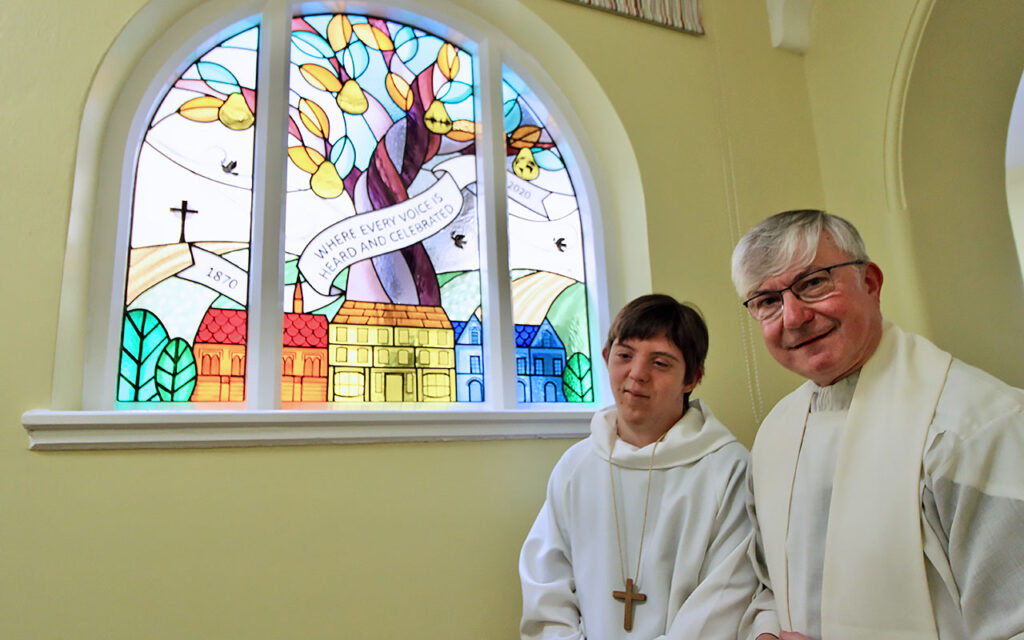
In 2020, the school celebrated its 150th anniversary. In more recent years, the school has increasingly supported children and young people with a range of communication and multi-sensory challenges and in recognition of this, in 2021, changed its name to St John’s Catholic Specialist School.
